
National Electrical Safety Code (NESC)
By R.W. Hurst, Editor
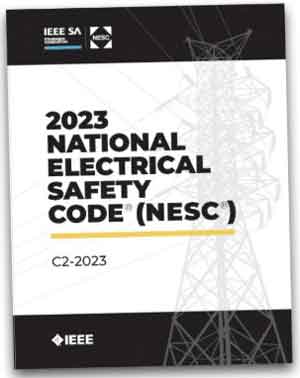
The National Electrical Safety Code (NESC) establishes safety rules for overhead and underground electric supply systems, defining inspection practices, clearance distances, grounding methods, and work rules that protect utility workers and the public.
NESC exists because electrical hazards extend far beyond buildings. Overhead lines, underground distribution systems, substations, and utility infrastructure operate in public spaces where failures can injure workers and the general public alike. These risks build on principles introduced in basic electrical safety, but are intensified by traffic exposure, weather, and uncontrolled access.
Many explanations of the NESC stop at a short definition. That approach misses what makes this code important in practice. The NESC is not just a technical document; it is a safety framework used daily by utilities, inspectors, engineers, and contractors to reduce risk in systems that cannot be de-energized easily and are constantly exposed to weather, traffic, and human activity. This real-world focus aligns closely with broader electrical safety at work programs where energized conditions are unavoidable.
NESC vs NEC: Why the Difference Matters
The National Electrical Safety Code and the National Electrical Code are often confused, but they serve different purposes and apply to different parts of the electrical system. The NEC governs electrical installations inside and on buildings, including residential, commercial, industrial, and institutional facilities. It focuses on premises wiring, equipment installation, grounding, bonding, and overcurrent protection within controlled environments, concepts reinforced through formal electrical safety certification.
The National Electrical Safety Code applies to electric supply and communication systems that deliver electricity to those buildings. It governs overhead and underground utility infrastructure, such as conductors, poles, towers, and substations, which are typically located in public or uncontrolled spaces. The NESC addresses hazards unique to outdoor systems, including vehicle contact, mechanical loading, weather exposure, vegetation growth, and public accessibility, all of which are central concerns in electrical engineering safety.
The practical dividing line between the two codes is usually the point of service. On the utility side, the NESC applies. On the customer or premises side, the NEC applies. Understanding where one code ends and the other begins is essential for accurate inspections, proper compliance, and effective risk reduction across the electrical system.
What the National Electrical Safety Code Covers and Why It Exists
IEEE publishes the NESC, which applies primarily to electric supply and communication systems. Its purpose is to safeguard workers and the public by establishing minimum safety requirements for the installation, operation, and maintenance of these systems.
Unlike the NEC, which governs wiring inside buildings, the NESC focuses on infrastructure such as overhead distribution lines, transmission corridors, substations, guy wires, poles, underground vaults, and utility crossings. These systems present unique hazards, including long spans, mechanical loading, vehicle impact, vegetation contact, and public exposure. Many of these conditions are also encountered on active job sites where construction electrical safety must account for temporary changes and shifting clearances.
The code exists because experience has shown that outdoor electrical systems fail differently from interior wiring. Wind, ice, corrosion, ground movement, and accidental contact all play a role. The NESC reflects decades of incident analysis and field experience rather than theoretical installation ideals.
How the NESC Is Structured and Used in the Field
One reason many professionals struggle with the NESC is that few articles explain how the document itself is organized or how inspectors actually use it. The code is divided into several major parts, each serving a different purpose during inspections and design reviews.
The first sections address substations, including grounding, clearances, and protective arrangements. Later sections focus on overhead lines, covering conductor spacing, pole strength, guying, and clearances over roads, buildings, and walkways. Underground line rules address vaults, manholes, burial depth, and mechanical protection. Work rules define how tasks are performed safely around energized systems.
During inspections, these sections are not read linearly. Inspectors typically move back and forth between clearance tables, strength requirements, and grounding rules, depending on what they observe in the field. Proper grounding performance is a recurring concern and is often evaluated using accepted electrical safety grounding practices rather than assumptions.
NESC and Electrical Safety Inspections in Practice
Most online content fails to connect the NESC to real electrical safety inspections. In practice, NESC-based inspections are observational, judgment-based, and context-dependent.
A typical NESC-based inspection may include evaluating conductor clearances over roadways, checking pole condition and loading, verifying guy wire placement and protection, assessing grounding continuity, and identifying encroachments such as trees, signage, or construction activity. Inspectors also look for evidence of deterioration, past damage, or unauthorized attachments.
Unlike indoor inspections, NESC inspections often involve conditions that change over time. Seasonal vegetation growth, soil movement, traffic patterns, and weather exposure mean that compliance is not static. A system that met clearance requirements when installed may no longer be compliant years later.
This ongoing exposure is why inspections are central to the NESC’s intent, not an afterthought.
Legal Adoption and Enforcement Considerations
Another gap in most NESC articles is the legal context. The NESC is not automatically law nationwide. Instead, it is adopted by individual states, municipalities, or regulatory agencies, often with amendments.
In some jurisdictions, NESC compliance is mandatory for public utilities and communication providers. In others, it is referenced indirectly through utility commissions or safety regulations. This matters during inspections because enforcement authority and liability depend on how the code is adopted locally.
From a risk standpoint, courts and regulators often treat the NESC as a benchmark for reasonable safety practices, even where adoption is partial. Utilities and contractors are frequently judged against NESC requirements following incidents that result in public injury or infrastructure failure.
Common Inspection Issues Identified Under the NESC
Field experience shows that certain issues appear repeatedly during NESC-based inspections. These include inadequate conductor clearances due to road resurfacing or building additions, deteriorated poles or crossarms, improper guy wire guards in public areas, and compromised grounding systems.
Vegetation management is another frequent concern. Tree growth near energized conductors remains one of the most persistent causes of electrical incidents. The NESC provides minimum clearance requirements, but inspectors must also exercise judgment based on species, growth patterns, and local conditions.
Why the NESC Matters Beyond Compliance
The NESC is often seen as a compliance document, but its deeper value lies in reducing risk. Electrical supply systems operate at high energy levels and are often inaccessible to the public until something goes wrong. When failures occur, consequences can be severe, including events associated with electrical explosion.
From a safety management perspective, the NESC provides a common language for engineers, inspectors, contractors, and regulators. It allows safety decisions to be justified using established criteria rather than opinion or convenience.
Utilities that treat the NESC as a living safety tool rather than a static rulebook tend to experience fewer incidents, lower liability exposure, and more consistent inspection outcomes.
Recent Updates and Ongoing Change
The NESC is revised on a regular cycle to reflect new technology, materials, and incident data. Changes often address emerging issues such as communication attachments, shared corridors, and increased public exposure.
Understanding what has changed, and why, is essential for inspectors and engineers. Relying on outdated assumptions can lead to missed hazards or incorrect enforcement decisions.
Practical Tools That Improve NESC Compliance
To make the NESC usable rather than abstract, many organizations rely on supplemental tools such as inspection checklists, clearance reference tables, and photographic guides showing acceptable and unacceptable conditions.
Providing inspectors with these practical aids improves consistency and reduces reliance on memory alone. It also supports defensible inspection decisions when findings are questioned.
Closing Perspective
The National Electrical Safety Code is best understood as a field-tested safety framework rather than a theoretical standard. Its value lies in how it is applied during real inspections, under real conditions, with real consequences.
Articles that only define the NESC fail to capture its purpose. By focusing on inspections, judgment, legal context, and lived experience, this page provides practical insight that professionals can actually use. That practical relevance is what ultimately makes the NESC effective and valuable.
Arc Flash Group Training

We can present this Course to your electrical engineering and maintenance staff, on your premises, tailored to your specific equipment and requirements. We are ready to help design this program for you. Click on the link below to request a FREE quotation.